
Why Power Factor Matters: How Poor Power Factor Increases Electricity Costs for UK Businesses
Most businesses focus on how much electricity they use.
But there is another important detail that often gets missed:
Power factor.
For many UK businesses, poor power factor can quietly increase electricity costs. This is especially true for sites using motors, pumps, refrigeration, air conditioning, compressors, lifts, production equipment or heavy electrical loads.
At Business Sense, we help businesses make sense of their energy costs, spot hidden charges and understand where savings can be made.
Power factor is one of those hidden areas that can make a real difference.
Poor power factor can lead to:
Higher electricity bills
Reactive power charges
Greater demand on your supply
Extra strain on electrical equipment
Less efficient energy usage
Reduced capacity for future growth
Understanding power factor can help your business reduce waste, improve efficiency and make better energy decisions.
What is power factor?
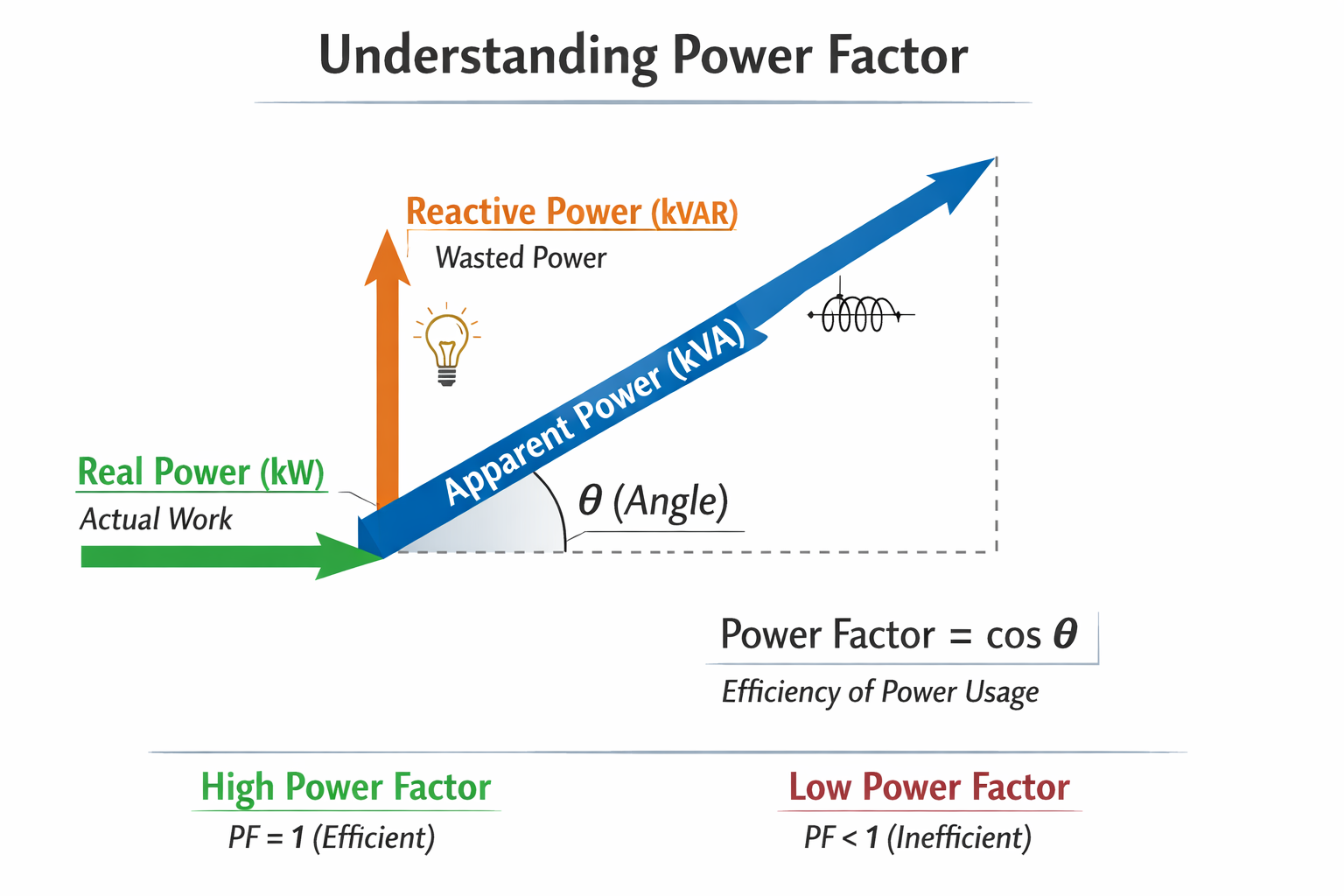
Power factor measures how efficiently your business uses the electricity supplied to it.
The image above shows this as a power triangle.
There are three key parts:
Real Power, measured in kW
Reactive Power, measured in kVAR
Apparent Power, measured in kVA
Power factor is the relationship between useful power and total supplied power.
A power factor of 1 means your electricity is being used efficiently.
A power factor below 1 means some of the power supplied to your site is not being converted into useful work.
In simple terms:
Your business may be pulling more power from the grid than it actually needs to do the job.
Real power, reactive power and apparent power explained
To understand why power factor matters, it helps to break the triangle down.
Real Power: kW
Real power is the electricity that does the useful work.
It powers things like:
Lighting
Computers
Machinery
Heating systems
Production equipment
Refrigeration
Pumps and motors
This is the electricity your business actually benefits from.
It is the power doing the work.
Reactive Power: kVAR
Reactive power does not perform useful work in the same way.
It is often created by equipment that needs magnetic fields to operate.
This can include:
Motors
Transformers
Compressors
Air conditioning units
Refrigeration systems
Pumps
Welding equipment
Reactive power is not always a problem.
Many businesses need some reactive power for equipment to function.
The issue comes when there is too much of it.
Too much reactive power makes your electricity supply less efficient.
Apparent Power: kVA
Apparent power is the total power supplied to your site.
It includes both:
Useful power
Wasted or reactive power
If your power factor is poor, your business needs more kVA to deliver the same amount of useful kW.
That extra demand can increase your costs.
It can also put extra strain on your electrical infrastructure.
Why poor power factor increases electricity costs
Poor power factor can affect your electricity costs in several ways.
Some are obvious on the bill.
Others are hidden inside demand, capacity or network-related charges.
1. You may pay reactive power charges
Some UK business electricity contracts include charges for reactive power.
These may appear on your bill as:
Reactive power
kVARh
Excess reactive energy
Power factor charges
Capacity-related charges
If your site has a low power factor, you may be paying for electricity that is not doing useful work.
This is one reason why a proper Business Savings Review can be so useful.
Rather than only looking at the headline unit rate, Business Sense reviews the wider cost picture. That includes usage, contract rates, supplier data, capacity and other areas where your business may be overpaying.
2. Your site may need more supply capacity
A poor power factor increases the apparent power your site needs.
That means your business may need a larger electrical capacity than expected.
This can affect:
Agreed capacity charges
Maximum demand
Network costs
Future expansion plans
The ability to add new machinery or equipment
For example, two businesses could use the same amount of useful power in kW.
But the business with poor power factor may need more kVA from the grid.
That makes the site less efficient and potentially more expensive to run.
3. Poor power factor can put strain on your electrical systems
Low power factor increases the current flowing through your electrical system.
This can affect:
Cables
Transformers
Switchgear
Motors
Distribution boards
Site infrastructure
More current can mean more heat, more losses and less spare capacity.
Even if the cost is not obvious straight away, poor power factor can still affect operational performance.
Over time, this can reduce efficiency and increase pressure on your electrical infrastructure.
4. Poor power factor can hide wider energy efficiency issues
Poor power factor is often a sign that your site should be reviewed in more detail.
Common causes include:
Oversized motors
Old machinery
Poorly maintained equipment
Heavy inductive loads
Inefficient HVAC systems
Refrigeration running harder than needed
Equipment left running when not in use
Lack of power factor correction
This is why power factor should not be looked at on its own.
It should form part of a wider Energy Solutions review.
Business Sense helps businesses look at the full picture, from energy procurement and usage through to infrastructure, renewables and long-term efficiency planning.
What is a good power factor?
A high power factor is usually close to 1.
As a simple guide:
1.00 is excellent
0.95 is generally good
Below 0.90 may need investigation
Below 0.85 could be costing your business money
The lower your power factor, the more inefficient your electricity supply becomes.
For example, a power factor of 0.70 means your business is drawing much more total power than it is converting into useful work.
This can result in avoidable costs.
Which UK businesses are most affected by poor power factor?
Poor power factor is more common in businesses with larger electrical loads.
It can affect many sectors, including:
Food production sites
Engineering firms
Warehouses
Cold storage facilities
Farms
Leisure centres
Workshops
Any business using motors, compressors, pumps, refrigeration or heavy electrical equipment should check its power factor.
For these businesses, energy costs can be a major overhead.
Small improvements in efficiency can make a meaningful difference.
How can you check your power factor?
You can start by reviewing your electricity bill.
Look for terms such as:
kVA
kW
kVARh
Reactive energy
Power factor
Capacity charge
Maximum demand
Excess capacity
If your business has half-hourly metering, your usage data may also help show when poor power factor occurs.
This can help identify whether the issue is linked to certain equipment, operating hours or production patterns.
If you are unsure what your bill means, Business Sense can review it for you.
A proper review should identify:
Your current energy rates
Your contract terms
Your usage patterns
Your capacity charges
Possible reactive power charges
Whether poor power factor may be affecting your costs
Where savings may be available
How can poor power factor be improved?
The most common solution is power factor correction.
This usually involves installing equipment that reduces the amount of reactive power your site draws from the grid.
This can help improve efficiency and reduce unnecessary demand.
Other improvements may include:
Maintaining motors and pumps
Replacing inefficient equipment
Avoiding oversized machinery
Switching equipment off when not in use
Reviewing HVAC and refrigeration systems
Monitoring half-hourly usage data
Checking site capacity and demand patterns
The right solution depends on your site, equipment and energy contract.
It is always worth reviewing the numbers first.
Is power factor correction worth it?
For some businesses, yes.
Power factor correction can help reduce:
Reactive power charges
Demand on the electrical supply
Network-related costs
Electrical losses
Pressure on site infrastructure
It may also free up electrical capacity for future growth.
This can be helpful if your business plans to add:
New machinery
EV chargers
Heat pumps
Refrigeration
Production lines
Additional buildings or units
Power factor correction is not right for every site.
But many businesses never check.
That means they could be missing an opportunity to reduce costs and improve energy efficiency.
Power factor and long-term energy planning
Power factor should also be considered alongside future energy plans.
For example, your business may be thinking about:
Solar panels
Battery storage
EV charging
Heat pumps
New production equipment
Site expansion
Lower carbon operations
If your electrical infrastructure is already under pressure, poor power factor could make future upgrades harder or more expensive.
This is why it can be useful to review power factor alongside renewable energy options and wider energy management.
A more efficient site is often better placed for future investment.
Real business savings start with better visibility
Energy bills can be difficult to understand.
Many businesses only look at the unit rate and standing charge.
But the real cost picture can include:
Unit rates
Standing charges
Capacity charges
Reactive power charges
Contract renewal dates
Meter profile
Half-hourly data
Peak and off-peak usage
Supplier terms
Commission and broker fees
This is where independent advice can help.
Business Sense provides clear, transparent cost reviews so businesses can see what they are paying, where savings may be available and what action makes sense.
You can also view the Business Sense case studies to see examples of how structured energy reviews have helped businesses reduce costs.
Why businesses should not ignore power factor
Poor power factor is easy to overlook.
It is not always obvious on an electricity bill.
But it can still have a real impact on costs.
It can mean your business is:
Paying for inefficient power use
Drawing more supply capacity than needed
Putting extra strain on electrical equipment
Missing opportunities to reduce costs
Limiting future growth
For energy-heavy businesses, improving power factor can be a practical way to make electricity usage more efficient.
It is not just about reducing waste.
It is about understanding how your business uses energy and making better decisions.
Get your business electricity usage reviewed
If your business has high energy usage, large equipment or unexplained electricity costs, your power factor is worth checking.
Business Sense can review your latest electricity bill and help identify whether poor power factor, reactive power charges, capacity costs or contract rates are adding unnecessary costs.
You will receive clear, independent advice based on your actual usage and supplier data.
No jargon.
No pressure.
Just a clearer view of where your business could save.
Start your free Business Savings Review today and find out whether your electricity costs are working harder than they need to.